
Poor early qualification
Generic forms collect too much from unsuitable leads and too little from strong ones.
FastDox can structure the journey from first enquiry through eligibility, evidence, authority, review and case progression — creating a usable claim record instead of an inbox trail.
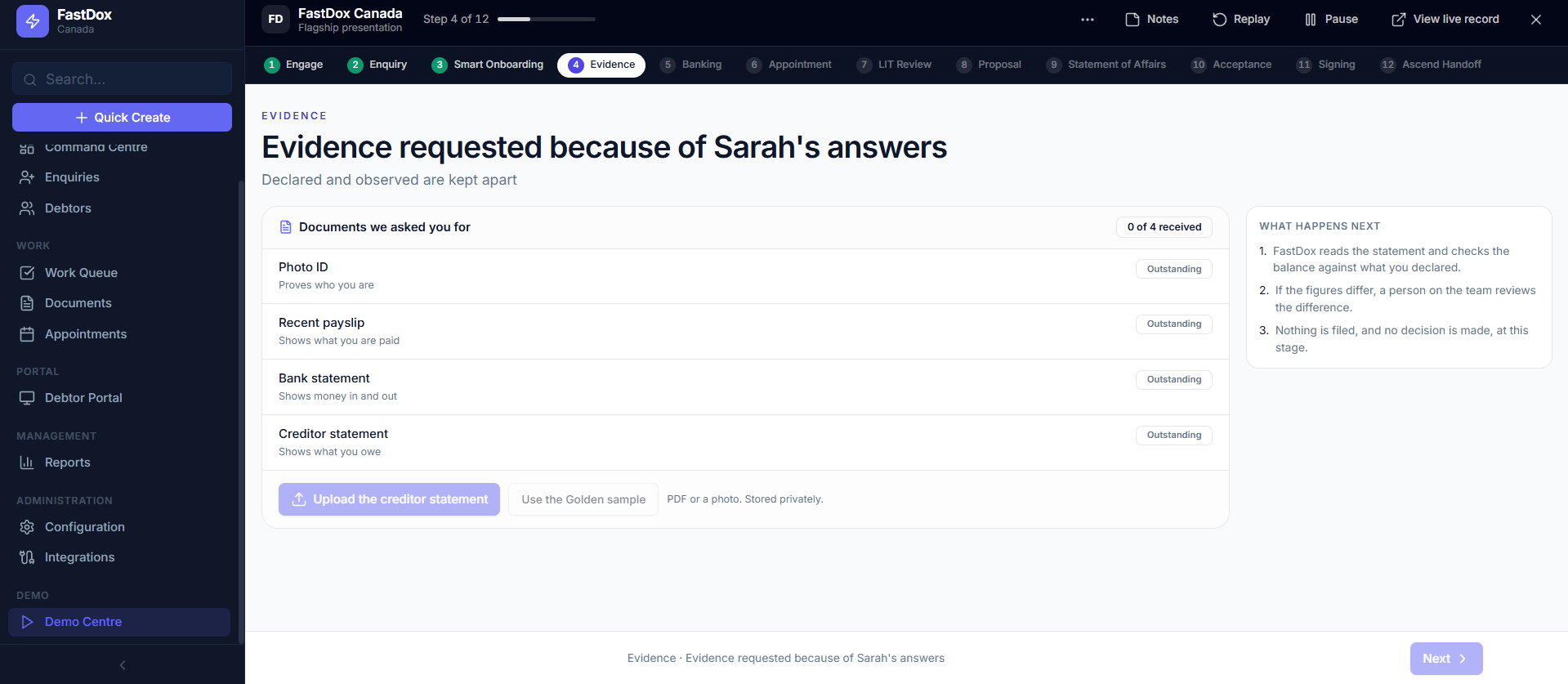
Claims teams lose time when intake is unstructured, evidence arrives piecemeal and staff must manually work out what is missing before they can assess viability.
Generic forms collect too much from unsuitable leads and too little from strong ones.
Documents, dates, parties and supporting facts often arrive through multiple channels.
Cases stall when next actions, authority or review tasks are not linked to the state of the claim.
Each capability operates against the same record, so information captured at the front of the journey can drive evidence, review, workflow and downstream handoff.
Ask claim-type-specific questions and branch based on incident, limitation, injury, liability or service criteria.
Request the right records, correspondence, photographs, reports or documents based on the answers given.
Summarise the chronology, surface missing facts and organise evidence for staff review.
Create tasks, approvals, signatures and handoffs from claim state rather than manual diary management.
The journey is designed so each step creates the state required by the next rather than generating another disconnected document or inbox task.
Establish whether the enquiry meets the initial criteria.
Collect structured facts, parties, dates and circumstances.
Request and organise the material needed to support the claim.
Route the claim into review, appointment, authority/signing and downstream case management.
The objective is not automation for its own sake. FastDox is designed to remove repeatable administration, surface genuine exceptions earlier and give skilled people better-prepared work.
We’ll tailor the flow to your qualification rules, evidence requirements, authority documents and case-management handoff.